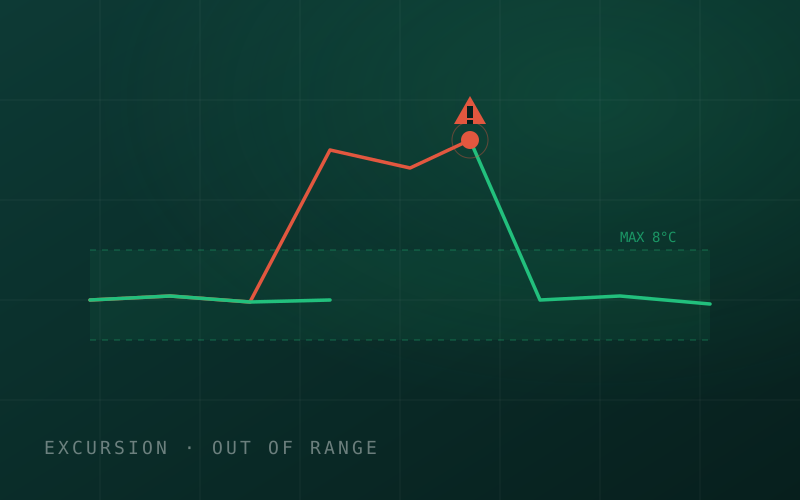
A temperature excursion — any deviation outside a product's approved range — is not automatically a disaster, but how you handle it decides whether you keep good product, avoid releasing bad product, and pass your next inspection. The wrong first move (destroying product, or quietly releasing it) is often worse than the excursion itself.
What counts as an excursion
An excursion is any time the product environment goes outside its labelled range — a fridge exceeding 8°C, a freezer warming above its limit, a warehouse breaching controlled-room-temperature limits. It is a deviation, which means it triggers your quality process — not an automatic write-off.
The first response: quarantine, don't react
The single most important rule: do not destroy or release affected product before it has been assessed. Instead:
- Quarantine the affected stock so it cannot be shipped or used.
- Capture the complete temperature record — how far outside range, and for how long.
- Secure the data and open a documented deviation investigation.
Investigate: root cause and extent
The investigation establishes two things: why it happened (equipment failure, door left open, power loss, HVAC fault) and how bad it was (magnitude and duration, and which product is affected). Both feed the impact assessment and the corrective actions.
Assess impact against stability data
Whether an excursion matters depends on the product. Using the product's stability data — and, for cumulative effects, a mean kinetic temperature assessment — you judge whether the deviation stayed within what the product can tolerate. This is a science-based decision, documented, not a guess.
Decide, then prevent
Make a documented disposition decision: release if stability data supports it, reject if it does not. Then close the loop with CAPA — corrective action to fix the immediate cause and preventive action to stop recurrence, with evidence that it worked.
Frequently asked questions
What is a temperature excursion?
Any deviation of a product's environment outside its approved range — a deviation to investigate, not automatically a loss.
What should I do first?
Quarantine the product (don't destroy or release), capture the full data, and open a documented investigation.
Does it mean the product is ruined?
Not necessarily — it depends on the product's stability data and how far and long the temperature deviated.
How do I decide whether to release?
Make a documented, stability-data-based decision on magnitude and duration, sometimes via MKT; reject if the data doesn't support release.
Key takeaways
- An excursion is a deviation to investigate — not an automatic write-off.
- Quarantine first; never destroy or release before assessment.
- Judge impact against stability data, using MKT for cumulative effects.
- Document the decision and close with effective CAPA; real-time alarms let you act in time.
Related guides
Get new guides by email
Practical monitoring, mapping and calibration guides, straight to your inbox. No spam — unsubscribe anytime.