Monitoring · Mapping · Calibration

Keep controlled environments
in range — and prove it.

Valitrac is the independent resource for environmental monitoring, ISO 17025 calibration and GDP temperature mapping. Learn what good looks like, compare the market, and get matched with vetted providers — free.

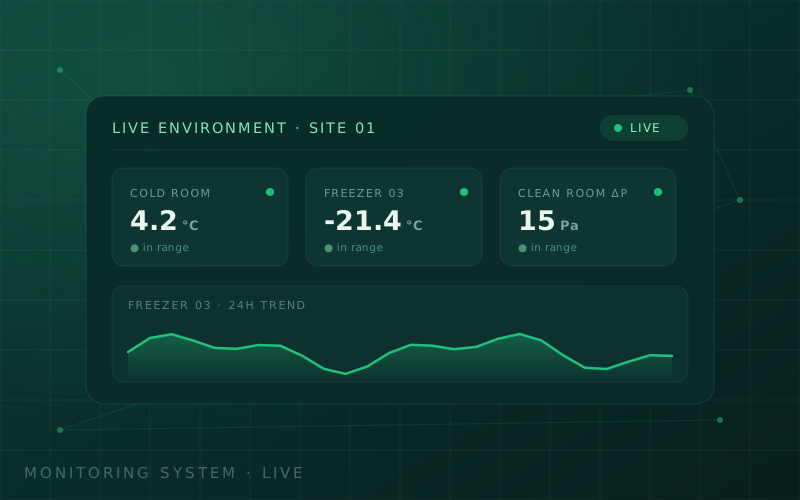
Live Environment · Site 01 LIVE
Cold Room · Temp
4.2°C
SET 2.0 – 8.0 °C · in range
Store · Humidity
54%RH
SET 35 – 65 %RH · in range
Lab · CO₂
612ppm
SET < 1000 ppm · in range
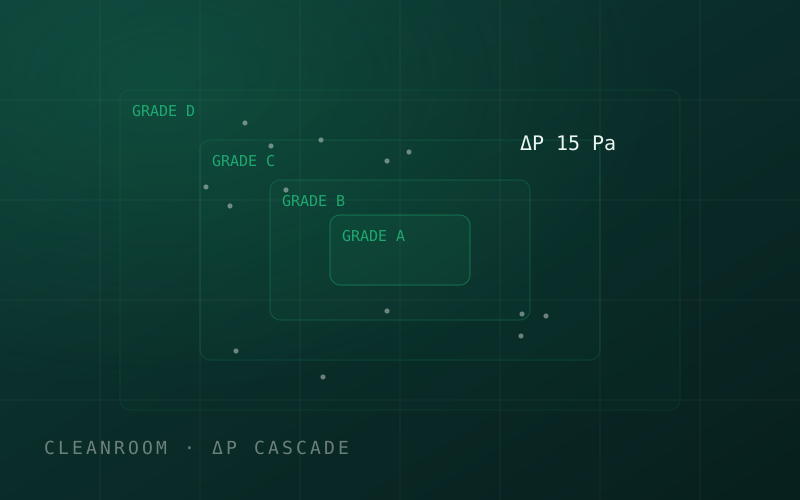
Clean Room · ΔP
15.4Pa
SET 10 – 20 Pa · in range
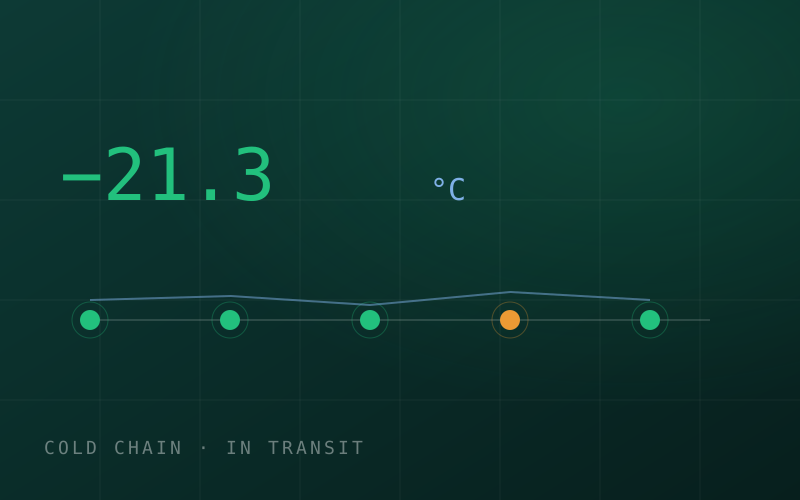
Freezer 03 · 24h trend−21.3 °C

Trusted across regulated environments

Pharma & Life Sciences Food & Beverage Logistics & Cold Chain Hospitals & Pharmacy Labs & R&D Manufacturing
What we cover

Everything a controlled
environment depends on

Independent guides and market comparisons across the four pillars of environmental monitoring. Learn what good looks like — then get matched with providers who deliver it.
Pharmaceutical warehouse being temperature mapped with data loggers
Qualification

Temperature & Humidity Mapping

What a GDP/WHO-compliant mapping study actually involves — protocol, sensor placement, worst-case seasons and reporting — plus how to get matched with accredited mapping providers.

Learn more →
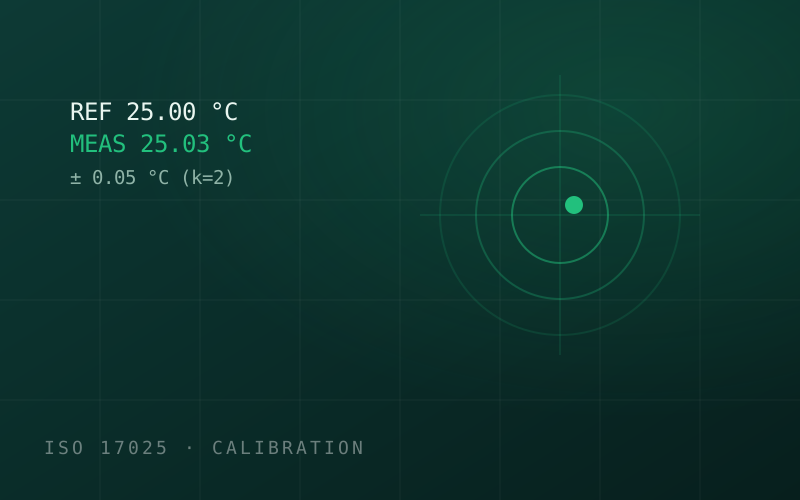
ISO 17025 accredited calibration laboratory with precision instruments
Traceability

ISO 17025 Calibration Support

What ISO 17025 and UKAS accreditation really mean, what a compliant certificate must contain, and how to find a calibration lab that satisfies inspectors.
Learn more →
Environmental monitoring sensors and control hardware
Systems

Monitoring Systems

Compare continuous monitoring systems — wired vs wireless, alarms, data integrity, 21 CFR Part 11 — and get matched to the right platform for your sites, not one vendor’s catalogue.
Learn more →
Quality assurance compliance audit in a controlled facility
Compliance

GDP & GMP Audits

What GDP, GMP Annex 1 and WHO expect from your monitoring programme — and how to connect with providers who can audit it and close the gaps before an inspector does.

Learn more →
What we measure

Every parameter that
your products depend on

Controlled environments rarely fail all at once. They drift — at a door, near a duct, on a top shelf in summer. Mapping, monitoring and calibration all target the same parameters — the ones that decide whether your product stays viable.

Temperature
The core of cold-chain and GDP compliance — from −80°C freezers to 25°C stability stores. Mapped to find hot and cold spots, monitored continuously, calibrated annually.
Relative Humidity
Critical for tablets, powders, biologics and packaging integrity. Often overlooked until a product deviation forces the question.
CO₂ & Air Quality
Incubators, controlled-atmosphere storage and occupied spaces. Where people and process share the same air, ppm matters.
Differential Pressure
Cleanroom cascades and containment. Annex 1 expects continuous evidence that your pressure regime holds during operations.
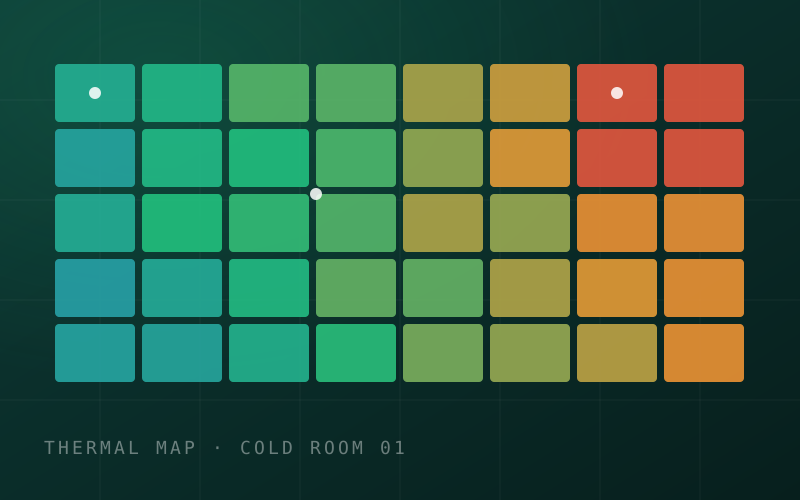
Cold Room 01 · Thermal Map15 sensors
2°C8°C+

Warm zone detected near loading door (top-right). Typical finding: instrument the extremes, not a tidy grid.

Why compare with us

The whole market, not one vendor

Most monitoring companies only sell you their own kit. We compare every major system and provider, then match you to the one that actually fits your sites.

Going straight to one vendor
The "one-stop shop" recommends the kit it sells, maps with its own loggers, and reports on its own system. You only ever see one option — and rarely know what you missed.
  • Recommendations follow the catalogue
  • Lock-in on hardware and software
  • No easy way to compare on price
Comparing with Valitrac
We compare systems and providers across the whole market and shortlist the best fit for your sites and budget. Free for you — providers pay us only when it's a good match.
  • Whole-market comparison, not one catalogue
  • Matched to your needs and budget
  • Free to use, no obligation
Insights

Practical guides, no jargon

Pharmaceutical warehouse temperature mapping study in progress
Temperature Mapping

The complete guide to GDP-compliant temperature mapping in pharmaceutical warehouses

From the regulatory framework to sensor placement to a report that survives an FDA or EMA inspection — everything a mapping study needs to get right first time.

Calibration certificate and precision reference thermometer
ISO 17025
ISO 17025 calibration: what it means for your data loggers

Accredited calibration, traceability to national standards, and what a compliant certificate must contain.
Pharmaceutical cleanroom sterile manufacturing environment
Compliance
GMP Annex 1 (2022): what changed for environmental monitoring

Contamination Control Strategy, continuous monitoring and the deadlines sterile manufacturers can't miss.
Refrigerated cold chain logistics warehouse
Cold Chain
How many sensors does your mapping study actually need?

The WHO framework for sensor density, and the three positions that fail first in almost every warehouse.

How it works

From your question to a matched provider — in four steps

1
Tell us what you need
Share your sites, products, compliance standards and the challenge you’re facing. A few minutes — free, no obligation.
2
We compare the market
We assess vetted monitoring, mapping and calibration providers against your requirements — independently, across the whole market.
3
Get independent recommendations
Receive a shortlist matched to your needs, with the trade-offs explained in plain English. No sales pressure, ever.
4
Choose with confidence
Pick the best fit for your sites and budget. Providers pay us only when it’s a good match — so our advice stays impartial.
Common questions

Environmental monitoring, explained

What is temperature mapping, and is it required?
Temperature mapping characterises how temperature and humidity vary across a storage area over time, to prove every zone stays in range. For pharmaceutical storage it’s required under EU GDP guidelines, GMP Annex 1 and WHO Technical Report Series 961, and applies to warehouses, cold rooms, fridges, freezers and vehicles alike.
What is ISO 17025 calibration, and why does UKAS accreditation matter?
ISO/IEC 17025 is the international standard for the competence of calibration laboratories. Any lab can claim to “work to” it, but only a UKAS-accredited lab has been independently assessed. For GDP and GMP compliance, a UKAS-accredited certificate that states measurement uncertainty (k=2) and traceability to national standards is the gold standard.
How often should temperature sensors be calibrated?
Intervals should be risk-assessed and documented, but regulators typically expect 12-monthly calibration for temperature sensors in pharmaceutical storage as a baseline — plus recalibration after any damage, or before and after critical use such as mapping studies.
How many sensors does a mapping study need?
WHO guidance suggests a minimum of 9 sensors for rooms under 50 m², 15 for 50–300 m², and 15 plus one per additional 100 m² for larger warehouses — with extra units at doors, air-handling units, loading docks and floor/ceiling level.
Is Valitrac free to use?
Yes — Valitrac is free for buyers. We compare the market and match you with vetted providers; providers pay us a referral fee only when there’s a good match. It never changes the guidance we give.

Tell us what you need — we’ll match you

Share your sites and requirements. We’ll shortlist vetted systems and providers that fit, and make the introductions. Free, no obligation.