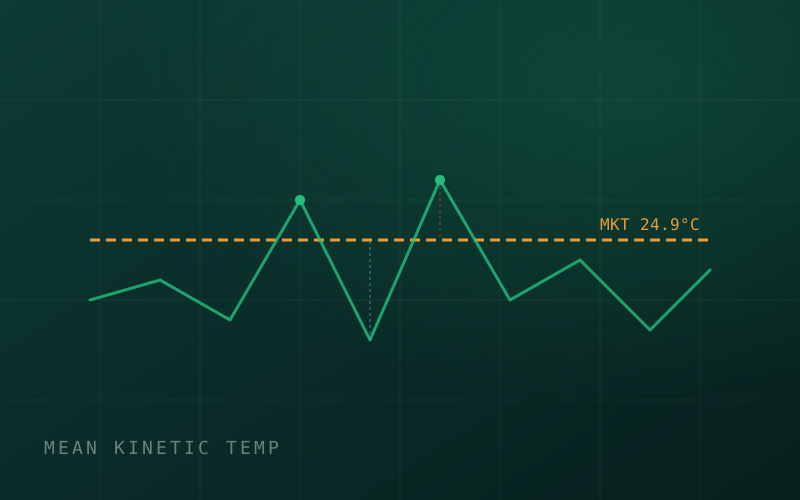
Mean kinetic temperature (MKT) is a single temperature that captures the real degrading effect of temperature on a product over time — not just its average. It weights warm periods more heavily than cool ones, which is why it is the tool of choice for assessing long-term storage and distribution excursions.
Why an average isn't enough
Chemical degradation speeds up disproportionately as temperature rises — a rule captured by the Arrhenius equation. A simple arithmetic average ignores this: a brief spike to 30°C and a spell at 2°C average out to a comfortable-looking number, even though the spike did most of the damage. MKT corrects for that by weighting higher temperatures exponentially, so the calculated value reflects the actual chemical impact.
The practical consequence: MKT is always the same as, or higher than, the plain average of the same data.

How it is calculated (in principle)
You do not need to compute it by hand — monitoring software does it — but the principle is worth understanding. MKT takes a series of temperature readings over a period, converts each to a rate using the Arrhenius relationship (with an activation energy, commonly around 83.14 kJ/mol as a default), averages those rates, and converts the result back to a temperature. The output is one figure that represents the whole period's thermal effect.
Where MKT is used
- Long-term storage — summarising whether a warehouse or cold room held products within an acceptable cumulative condition.
- Distribution excursions — assessing whether temperature deviations during transport compromised the product, against stability data.
- Stability programmes — MKT appears in ICH stability guidance, USP <1079> and WHO guidance as a way to express real-world conditions.
Frequently asked questions
What is mean kinetic temperature?
A single Arrhenius-weighted temperature expressing the cumulative thermal stress on a product over a period — reflecting temperature's true degrading effect.
How is it different from average temperature?
It weights hotter periods exponentially rather than equally, so MKT is always equal to or higher than the arithmetic mean.
When should MKT be used?
To summarise long-term storage and assess distribution excursions against stability data, as referenced in ICH, USP <1079> and WHO guidance.
Does a good MKT make an excursion acceptable?
Not automatically — only alongside valid stability data and a defined process. It must never average real excursions away.
Key takeaways
- MKT reflects the real, cumulative effect of temperature — not a simple average.
- Because it weights heat exponentially, MKT ≥ the arithmetic mean, always.
- Use it for long-term storage and excursion assessment against stability data.
- It supports science-based decisions; it is not a way to erase excursions.
Related guides
- Temperature excursion management
- Cold chain & GDP distribution
- The complete guide to GDP temperature mapping
Get new guides by email
Practical monitoring, mapping and calibration guides, straight to your inbox. No spam — unsubscribe anytime.