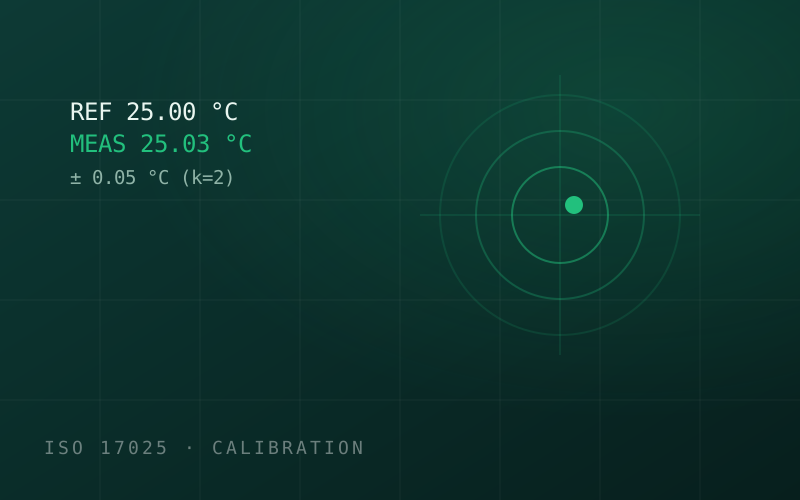
Ask most QA managers whether their temperature data loggers are calibrated and they'll say yes. Ask whether that calibration is ISO 17025 accredited, traceable to national standards, and states the measurement uncertainty — and the answers become much less certain.
Calibration is one of the most misunderstood requirements in pharmaceutical environmental monitoring. This guide explains what ISO 17025 actually requires, what a compliant certificate must contain, and how to quickly audit your existing records before an inspector does.
What is ISO/IEC 17025?
ISO/IEC 17025 is the international standard specifying the general requirements for the competence, impartiality and consistent operation of testing and calibration laboratories. A laboratory accredited to ISO 17025 has been independently assessed — in the UK by UKAS — and proven capable of producing technically valid, traceable results.
Crucially, any laboratory can say it "works to ISO 17025." Only a UKAS-accredited laboratory has been externally verified. For GDP and GMP compliance the difference matters enormously. Always verify accreditation at ukas.com before commissioning calibrations from a new provider.
Traceability: what it means in practice
Traceability means there is an unbroken documented chain of calibrations linking your sensor's measurement back to a primary national or international standard. In the UK this chain ultimately leads to the National Physical Laboratory (NPL) in Teddington, which maintains the UK's primary temperature standards.
When your certificate states "traceable to NPL," it means your sensor was calibrated against a reference thermometer, which was calibrated against a working standard, which traces back through a UKAS-accredited lab to NPL. Each link in that chain must be documented and maintained.
Measurement uncertainty: the most overlooked requirement
ISO 17025 requires that certificates state the measurement uncertainty of the calibration result. This is typically expressed as ±X°C at a confidence level — k=2, about 95% confidence, is standard for pharmaceutical applications.
Measurement uncertainty tells you how well your reference standard is itself known, and therefore how confidently you can trust the result. If a certificate simply states "error = +0.1°C" with no uncertainty, it is not compliant with ISO 17025, regardless of what the laboratory claims.
How to audit your existing calibration records
Run through this checklist against any certificate in your QMS:
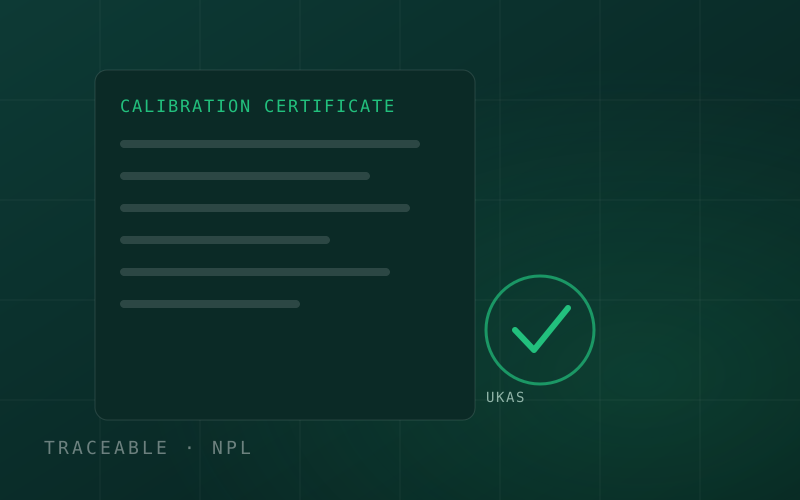
- Does it carry the UKAS symbol (or an equivalent national accreditation body for non-UK labs)?
- Is the lab's UKAS accreditation number stated and verifiable at ukas.com?
- Does it uniquely identify the instrument (serial or asset number)?
- Does it cover the full operating range of your application?
- Does it state the measurement uncertainty at each point?
- Does it include a traceability statement to national standards?
- Is it dated, and does it indicate the next calibration due date?
If any of these are absent, your record may not withstand GDP or GMP scrutiny. The most common failure is the absence of stated measurement uncertainty — many templates simply don't include it, even from otherwise reputable providers.
How often should you calibrate?
Intervals should be risk-assessed and documented. GDP guidance doesn't prescribe a fixed interval, but regulators typically expect 12-monthly calibration for temperature sensors in pharmaceutical storage as a baseline. Sensors in critical applications, those that have been damaged or shown anomalous readings, and those used in mapping studies should be calibrated before and after use regardless of the scheduled interval.
Need an accredited calibration lab?
Tell us about your instruments and we’ll match you with UKAS-accredited labs that meet GDP and GMP requirements.
Get new guides by email
Practical monitoring, mapping and calibration guides, straight to your inbox. No spam — unsubscribe anytime.