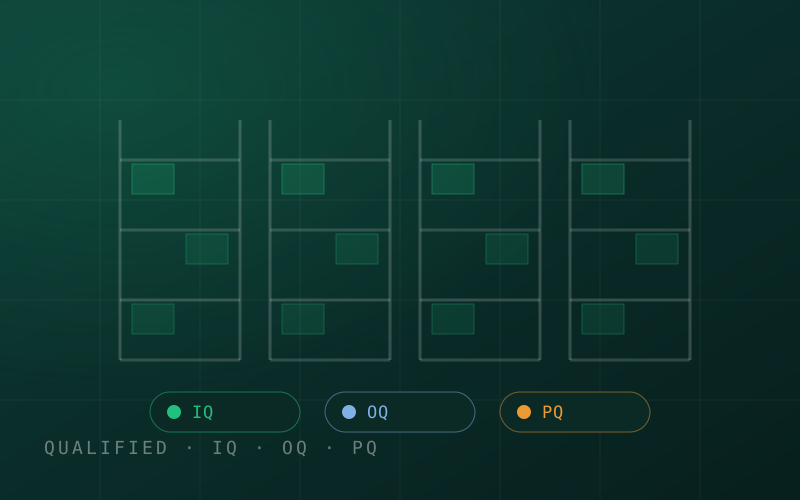
Warehouse qualification is the documented process of proving a storage area is fit to hold your products. It follows four stages — Design, Installation, Operational and Performance Qualification (DQ, IQ, OQ, PQ) — and temperature mapping is a key part of it.
Qualification vs validation
Qualification shows a facility or piece of equipment is fit for purpose; validation is the wider documented evidence that a process reliably delivers a compliant result. In practice, qualifying a warehouse is validation applied to a storage facility — and it is a regulatory expectation under GDP and GMP.
DQ — Design Qualification
DQ documents that the proposed design meets your User Requirements Specification: the right temperature range, capacity, HVAC design, monitoring system and alarms, before anything is built or bought.
IQ — Installation Qualification
IQ verifies that everything was installed correctly and to specification: HVAC and refrigeration units, the monitoring system and its sensors, calibration status of measuring instruments, utilities, and that documentation and drawings match reality.
OQ — Operational Qualification
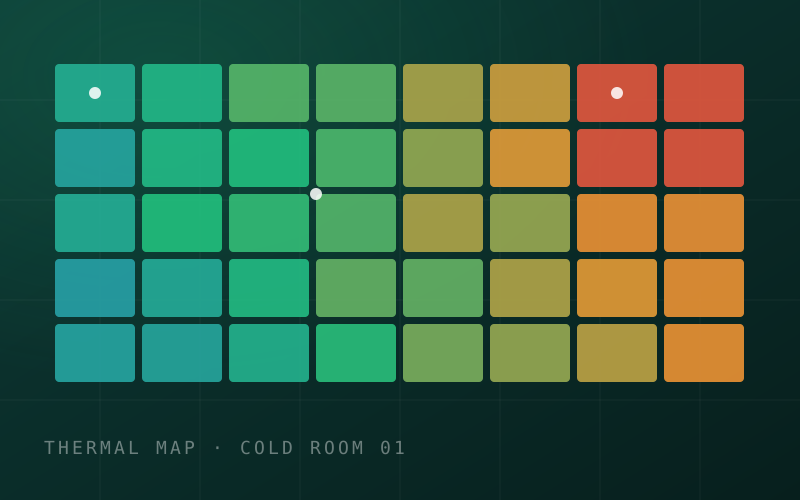
OQ proves the system works across its operating range. This is where the demanding tests live:
- Empty (at-rest) temperature mapping to characterise the space and find hot and cold spots.
- Door-open recovery — how quickly the space returns to range after doors are opened.
- Power-failure recovery — behaviour during and after a loss of power.
- HVAC / refrigeration failure and alarm testing to confirm warnings trigger correctly.
PQ — Performance Qualification
PQ demonstrates the warehouse performs consistently under real, loaded, operational conditions — including seasonal (summer and winter) mapping and review of routine monitoring data over an extended period. PQ is what proves day-to-day reality matches the qualified design.
Frequently asked questions
What is the difference between IQ, OQ and PQ?
IQ verifies correct installation; OQ proves operation across the range (including empty mapping and failure-recovery tests); PQ proves consistent performance under real loaded conditions over time.
Is mapping part of OQ or PQ?
Empty mapping and challenge tests sit in OQ; loaded and seasonal mapping sits in PQ. You need both.
When does a warehouse need requalification?
On significant change, when data suggests drift, and on a periodic risk-based schedule.
Qualification vs validation?
Qualification shows equipment/facilities are fit for purpose (DQ/IQ/OQ/PQ); validation is the broader evidence a whole process consistently meets its criteria.
Key takeaways
- Qualification runs in four stages: DQ, IQ, OQ, PQ — each to a pre-approved protocol.
- Empty mapping and failure-recovery tests belong to OQ; loaded and seasonal mapping to PQ.
- Define requalification triggers up front — change, drift and a periodic schedule.
- Qualification is validation applied to your storage facility, and inspectors expect it.
Related guides
- The complete guide to GDP temperature mapping
- Cold chain & GDP distribution
- Audit & inspection readiness
Not sure which provider you need?
Tell us about your sites and we’ll shortlist vetted monitoring, calibration and mapping providers that fit — free for buyers, no obligation.
Get new guides by email
Practical monitoring, mapping and calibration guides, straight to your inbox. No spam — unsubscribe anytime.