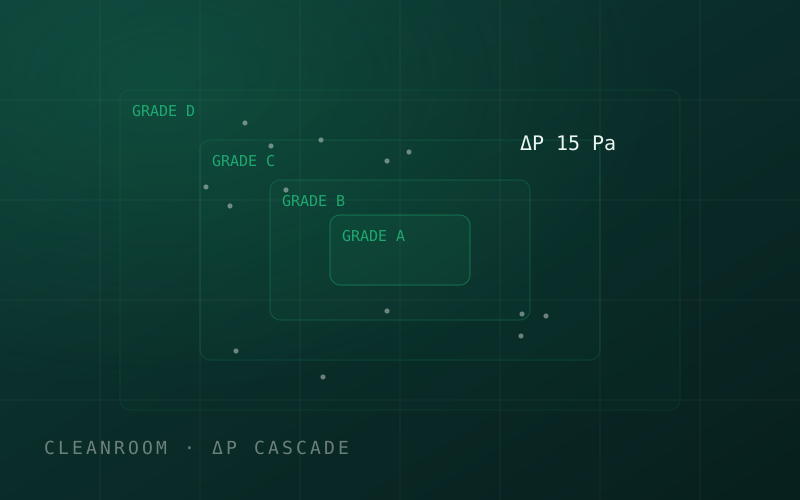
Cleanroom environmental monitoring is the routine measurement of airborne particles and micro-organisms to prove a cleanroom stays within its cleanliness grade. Under EU GMP Annex 1, it combines non-viable particle counting with viable microbial sampling, at a frequency and location set by risk.
The four cleanroom grades
- Grade A — the critical zone for the highest-risk operations (aseptic filling, making aseptic connections).
- Grade B — the clean background for Grade A during aseptic processing.
- Grade C and D — cleaner support areas for less critical stages of manufacturing sterile products.
Non-viable particle monitoring
Non-viable monitoring uses a particle counter to measure airborne particles at ≥0.5µm and ≥5µm. Grade A demands continuous, ideally real-time monitoring during critical activity so nothing is missed between samples; lower grades are monitored at a risk-based frequency. Trends matter as much as single results.

Viable (microbial) monitoring
Viable monitoring detects living organisms using several complementary methods:
- Settle plates — passive collection of organisms settling from the air (exposure generally limited to four hours in Grade A/B).
- Active air sampling — a volumetric sampler draws a known air volume across a growth medium.
- Contact (RODAC) plates — for surfaces.
- Glove and gown sampling — finger dabs and gown checks for personnel, the largest contamination source.
Locations, frequency and limits
Monitoring locations are chosen by risk — concentrated at the most critical points and where contamination is most likely. You set alert limits (an early-warning signal) and action limits (a defined response is required), and you trend results over time. Isolated results tell you little; a drifting trend tells you a lot.
What Annex 1 (2022) changed
The revised Annex 1 put the Contamination Control Strategy at the centre: monitoring must be justified within a documented, holistic CCS driven by Quality Risk Management. It reinforced continuous monitoring in Grade A, kept both viable and non-viable requirements, and raised expectations around data and trend review.
Frequently asked questions
What are cleanroom grades A, B, C and D?
Annex 1's four cleanliness grades: A is the critical aseptic zone, B its clean background, and C and D are cleaner support areas — each with defined particle and microbial limits.
Viable vs non-viable monitoring?
Non-viable counts airborne particles by size; viable detects living micro-organisms via settle plates, active air sampling and contact plates. Cleanrooms need both.
What is continuous monitoring?
Real-time, ongoing non-viable particle monitoring in Grade A (and typically B) throughout critical processing, so excursions during the process are captured, not just sampled.
How long can settle plates be exposed?
Generally no more than four hours in Grade A/B under Annex 1, to keep the medium viable and results meaningful.
Key takeaways
- Grades A–D each have particle and microbial limits you must maintain and prove.
- Monitor both non-viable particles and viable organisms, by risk-based location and frequency.
- Grade A needs continuous particle monitoring; trend everything.
- Annex 1 (2022) ties it all to a documented Contamination Control Strategy.
Related guides
- GMP Annex 1 (2022): what changed for monitoring
- Audit & inspection readiness
- Warehouse qualification: IQ, OQ & PQ
Not sure which provider you need?
Tell us about your sites and we’ll shortlist vetted monitoring, calibration and mapping providers that fit — free for buyers, no obligation.
Get new guides by email
Practical monitoring, mapping and calibration guides, straight to your inbox. No spam — unsubscribe anytime.