
Audit and inspection readiness means being able to prove, at any moment, that your monitoring and calibration are compliant — with the records to back it up. For a GDP or GMP inspection, the difference between a smooth visit and a critical finding is usually documentation and data integrity, not the equipment itself.
Who inspects, and what they focus on
In the UK the MHRA inspects against GDP and GMP; the FDA, EMA and other national authorities apply equivalent expectations. For environmental monitoring and calibration specifically, their attention falls on a predictable set of records.
The evidence inspectors expect
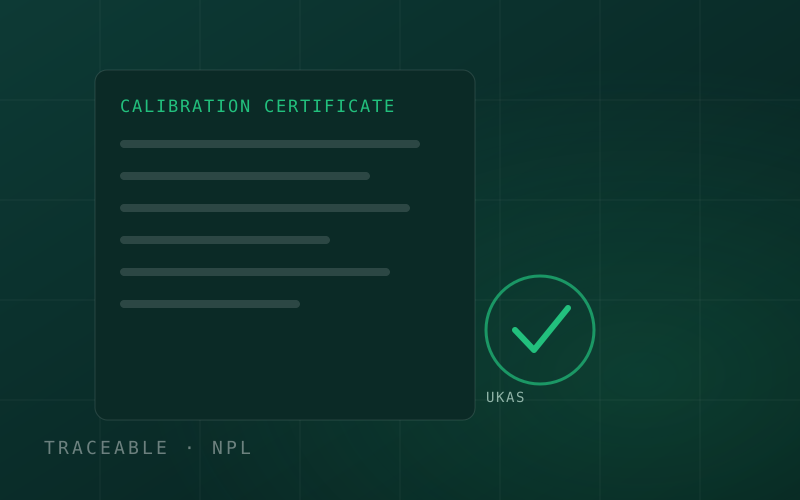
- Calibration certificates — in date, traceable to national standards, stating measurement uncertainty; ideally UKAS-accredited to ISO/IEC 17025.
- Mapping reports — both summer and winter, run to a protocol approved before the study, with sensor placement justified by risk.
- Monitoring and alarm records — complete, continuous, and reviewed, with evidence that alarms were acted upon.
- Deviations and CAPA — every excursion investigated, root cause identified, and corrective/preventive actions shown to be effective.
Data integrity: ALCOA+
Data integrity is where many inspections turn. Records must be Attributable, Legible, Contemporaneous, Original and Accurate — and, in the "+" extension, Complete, Consistent, Enduring and Available. In practice that rules out shared logins, editable spreadsheets with no audit trail, and monitoring systems whose data can be quietly changed. If an inspector cannot trust the data, nothing else you show them helps.
Common findings — and how to avoid them
How to stay inspection-ready
- Document control — current, version-controlled SOPs, protocols and reports that are easy to retrieve.
- Self-inspection — periodic internal audits and mock inspections to find gaps before a regulator does.
- CAPA discipline — a live system that closes actions and proves they worked.
- Inspection-day logistics — a document index, a prepared back room, and staff briefed on how to answer clearly and honestly.
Frequently asked questions
What do inspectors look at for monitoring and calibration?
In-date, traceable calibration certificates with uncertainty; seasonal mapping to an approved protocol; complete monitoring and alarm records; and deviations closed with effective CAPA.
What is ALCOA+?
Data must be Attributable, Legible, Contemporaneous, Original, Accurate — plus Complete, Consistent, Enduring and Available.
How do I prepare for an inspection?
Tight document control, periodic self-inspections, an effective CAPA system, up-to-date calibration and mapping, and prepared inspection-day logistics.
What are the most common findings?
Out-of-calibration instruments, missing seasonal mapping or protocol, incomplete records, weak CAPA, and data-integrity gaps.
Key takeaways
- Inspections are won or lost on documentation and data integrity, not equipment.
- Have in-date traceable calibration, seasonal mapping and complete monitoring records ready.
- Apply ALCOA+ to every record — no shared logins, no untracked edits.
- Stay ready continuously with self-inspection and a working CAPA system.
Related guides
- Cleanroom environmental monitoring (Grades A–D)
- ISO 17025 calibration explained
- Warehouse qualification: IQ, OQ & PQ
Not sure which provider you need?
Tell us about your sites and we’ll shortlist vetted monitoring, calibration and mapping providers that fit — free for buyers, no obligation.
Get new guides by email
Practical monitoring, mapping and calibration guides, straight to your inbox. No spam — unsubscribe anytime.