Monitoring that catches
the drift, day and night
A monitoring system watches your controlled environments around the clock — temperature, humidity, CO₂, differential pressure — and raises the alarm the moment something moves out of range. We help you compare systems and match with the right provider.
One dashboard for every
environment you run
Continuous monitoring means permanent, calibrated sensors across your fridges, freezers, cold rooms, warehouses, cleanrooms and stability chambers — all streaming to a central platform you can check from anywhere.
When a reading crosses a limit, the system alerts the right people immediately and keeps a tamper-evident record of what happened and what was done about it. The point isn't just data — it's reaction time and evidence: a shorter gap between an excursion starting and someone acting on it, and an audit trail an inspector will accept.
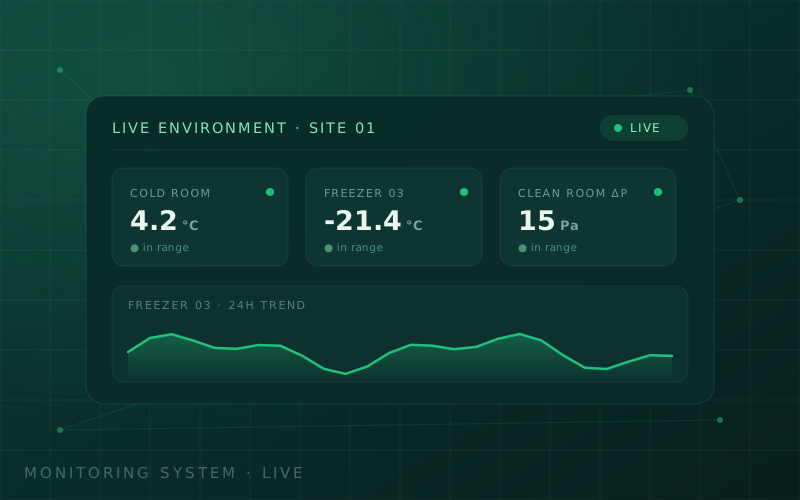
What separates a real system
from a box of sensors
Most systems can log a number. The difference is what happens next — and whether it will hold up under inspection.
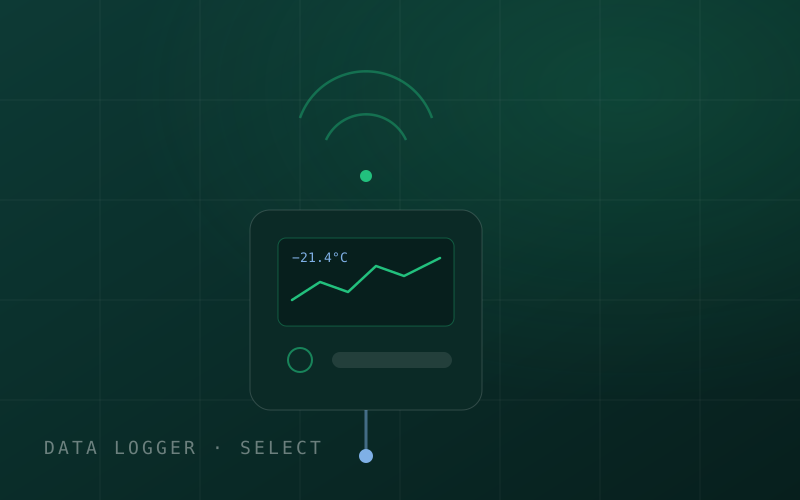
Wired or wireless?
It depends on the site
There's no universally right answer — the best system usually mixes both. What matters is matching the technology to each location's risk and construction:
- Wireless — fast to deploy and flexible, ideal for retrofits and many small points
- Wired — rock-solid for critical assets and new-builds, with no batteries to manage
- Hybrid — wireless coverage with a wired backbone for the highest-risk points
- Weigh up range, wall construction, battery life and IT security
Monitoring is only as good
as its foundations
The three pillars work together. A mapping study tells you where the sensors belong. ISO 17025 calibration keeps those sensors honest. Continuous monitoring then watches the whole environment, non-stop. Get one wrong and the others can't save you — so we look at all three when we match you.
Built for anywhere product
sits in a controlled space
If a temperature, humidity or pressure limit matters to your product — or to your auditors — continuous monitoring earns its place.
Monitoring systems, explained
What’s the difference between temperature mapping and monitoring?
Do I need wired or wireless sensors?
What does ‘21 CFR Part 11’ mean for a monitoring system?
How often do monitoring sensors need calibrating?
Can one system cover multiple sites?
Find the monitoring system that fits
Tell us your sites, the environments you run and what you need to prove. We'll shortlist systems that actually fit and introduce you — free.